WRITE FOR FSI-BLOG.COM

If you are sitting there thinking about contacting us with the old school approach, where you search write for us tech on Google, copy whatever email address comes up, and send over an article that was written for a client backlink and nothing else, then we are sorry but it is a no from us.

We are not being rude about it. We just want to save you the twenty minutes it would take you to write that email, and save ourselves the twenty seconds it takes to delete it.

Because the thing is, we do actually want writers. We want them quite badly. Just not that kind.

If you are quickly searching for our mail here is it: team @ fsi-blog.com


WRITE FOR US TECHNOLGOY AT FSIBLOG

Why This Page Exists

We are delighted to open this up, and the reason is simple enough, which is that despite everything that has happened with AI in the last two years, no LLM has replaced the human yet and it is not particularly close.

Humans have the experience. This industry runs on problem solving, and a model cannot solve a problem it has never seen anybody run into.

Think about what actually happened with AI and development. It can build a full stack website now, genuinely, from a prompt. But somebody still has to sit there and command it, somebody has to know what to ask for and know when the output is wrong and know why the thing broke. The AI did not remove the person, it just changed what the person is doing.

Writing works the same way and we do not know why people keep pretending otherwise.

Developer working at a desk with code on screen

What We Actually Want From You

We want the real writer who uses AI to build genuinely helpful content that answers something or shares an idea nobody has published yet.

Let us make that concrete, because it is easy to say and harder to picture.

What we want

You built the thing

Say you built a tool that converts a Next.js site over to Nuxt. You are the one who built it. You know why you built it, you know what kept breaking during the build, and you know the logic underneath it. Nobody else on earth knows that yet.

If you write that up, and you use AI to help you get the words down, that is completely fine with us. You are still the source of everything that matters in the piece.

You worked it out yourself

Or say you are an SEO, and you worked out an organic method for ranking blog posts that actually moves pages in the Google SERP. Not a theory you read somewhere, an actual thing you did that worked.

No GPT knows that. Kimi does not know it either. None of them know it, and none of them can know it, until the day you publish it and it enters the training data.

That is the uniqueness we are after.

So to be very clear about it, we are not asking you to sit and hand type a thousand word draft while refusing to touch a keyboard shortcut. We do not care how the words got onto the page. We care where the idea came from.

The idea has to be yours. That is the whole reason this page exists.

Slide comparing commodity and non commodity content
Open the full slide

Nobody Actually Searches For The Content Google Says It Wants

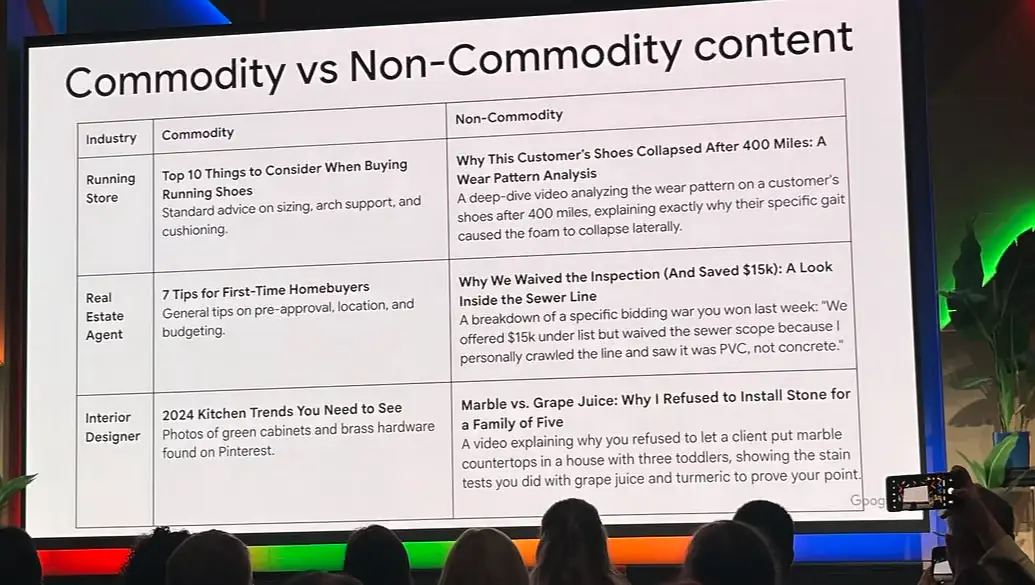
There was a slide going round the SEO world earlier this year, shown at one of Google's own events, splitting content into two columns. Commodity on the left, non-commodity on the right.

Commodity is the stuff anybody could write by reading the top ten results and rewording them. Non-commodity is the stuff only you could write, because you were there and nobody else was. Fair enough as far as it goes, and we do not really disagree with any of it.

But there is a question nobody on that stage answered and it is the one that actually matters if you run a website.

One of their own examples was an interior designer explaining why they refused to put marble countertops in a house with three toddlers, with stain tests using grape juice and turmeric to prove the point. Genuinely good piece of writing. Except who is typing that into Google? People search for best kitchen countertop materials. They search marble vs quartz. Those are the exact commodity queries Google is telling everyone it does not want to reward anymore.

So you can go and write the best first person piece anybody has produced on a subject and it sits there with almost no impressions, because there is no search behind it.

We are telling you this before you pitch us, not after. We still want that kind of writing, and we are going to keep asking for it, because a piece that only you could have written is worth having on the site whether it ranks in week one or not. Just do not send us something and then be surprised when the traffic takes its time.

About Links, Because This Is Where Most Pitches Fall Apart

Let us say you are an SEO agency sitting in California, and you want to pitch us, so you send over an article about the benefits of guest posting now that AI Overviews have landed in Google. Fine so far, that is a real topic and people genuinely want to read about it. Then somewhere in the middle of the body, out of nowhere, there is a link sitting on SEO services California.

That is spam and we are going to say no to it.

Not because you added a link, we have no problem with links at all. The problem is that you were writing a general article about guest posting and then California turned up from nowhere, or LA turned up from nowhere, and there was nothing in the piece leading anybody there.

Now flip it around

Say you are writing a PPC case study instead, or something about budgeting in digital marketing, and you are actually breaking down bidding costs and keyword competition and search volume in the California market. Now a California link makes complete sense, right? The article walked the reader there itself. The link is answering something the piece already raised.

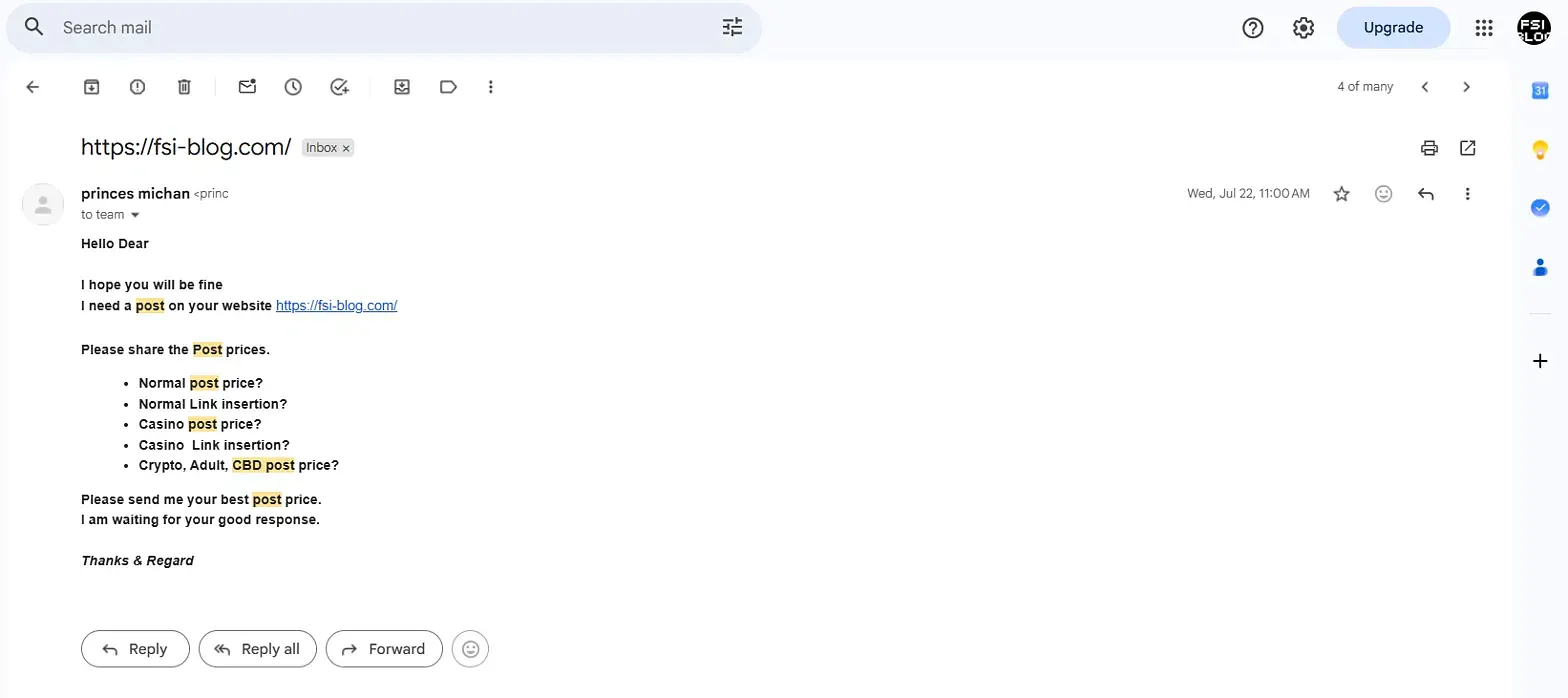
Same link. Same anchor text. Completely different thing. Also see the image below what type of mails we discourage:

Example of a guest post pitch with an unrelated commercial link dropped into the body copy
The kind of placement we turn down, and the reason why is usually visible in one glance.

About The Emails We Keep Getting

"I need only DO FOLLOW links and permanent posts with Google indexing, so please tell me your best price. And please tell me about your policies and rules."

Inbox, most weeks

"Normal post price? Normal link insertion? Casino post price? Casino link insertion? Crypto, adult, CBD post price?"

Also the inbox, same week

No. We discourage this and honestly those days have been gone for a while now.

We understand why the email exists. Somebody has a spreadsheet with two hundred sites on it and a monthly quota to hit.

But that is a numbers game being played at us rather than a conversation, and we are not the site for it.

Who We Want To Hear From

Our audience is developers at every level, plus designers, plus people who work adjacent to both.

So we are interested if you want to write about JavaScript, Python, Rust, WebAssembly, React, Figma or Tailwind CSS. That much is probably obvious.

But we are a tech site and by tech we do not only mean code.

If Anthropic ships a version of Claude that is more powerful than Mythos, that is tech and it is worth covering. If a phone launches with something genuinely new inside it, that is tech. If a browser changes how it handles something and it breaks half the internet for a morning, that is tech.

Now this is where people take a mile, so let us head it off. Do not send us crypto pitches on the grounds that crypto is technically technology.

We will absolutely take crypto and blockchain pieces, but the question we are going to ask is whether the post covers an actual technical update, an upgrade, or some piece of engineering. If Ethereum ships a new update and you are writing about what changed at the protocol level and what it means for people building on it, then yes, that is genuinely tech and we want it.

If it is price predictions and which coin is going to the moon, then no.

The same test applies to every other category. Is there real technology in this, or is the word technology just being used as a door?


Further Topics We Plan To Accept

Technology Trends

Analyze emerging technologies, discuss their impact on industries, and explore innovative applications transforming the way we work.

Digital Marketing Strategies

Share effective SEO techniques, content marketing strategies, social media tips, and proven methods for boosting online visibility.

Software and App Reviews

Provide in-depth, unbiased reviews of the latest software tools and applications that improve productivity and workflow.

Tech Guides and Tutorials

Write clear, step-by-step guides to help readers understand new technologies, install software, or master useful tools.

AJAX Solutions

Help readers troubleshoot AJAX challenges and understand how to create seamless, dynamic web applications without full page reloads.

Exploring Go Language

Provide insights into using the Go programming language, including concurrency handling, memory management, and code optimization.

PHP Tips and Tricks

Share debugging advice, performance optimization strategies, and common solutions for PHP development issues.

API Integration

Write about integrating APIs effectively, with a focus on REST, GraphQL, error handling, and troubleshooting best practices.

HTML Best Practices

Guide readers in creating structured, semantic, and accessible HTML while avoiding typical code pitfalls.

Python Insights

Share knowledge on Python fundamentals, advanced data manipulation, automation, and error-handling techniques.

XML

Explain XML parsing, validation, and data transformation methods to help users work confidently with structured data formats.

Command Line Basics

Simplify command line usage with clear explanations and solutions for common terminal issues across operating systems.

Technology Development Digital Marketing Tools And Workflow

Those boxes above are not a fence. They are just where most of what we publish happens to land, and if your idea sits slightly outside them but everything else on this page still applies to it, send it over and we will read it properly.

The way we think about this is roughly how TechTarget or PCMag or GeeksforGeeks think about it, and those three are honestly our reference point. None of them decide what counts as technology by looking at a category list. They decide by asking whether there is something real being explained, and whether the person explaining it actually knows the thing. A topic is welcome here if it teaches somebody something that was not already sitting in ten other articles.

Which means a piece about a niche build tool nobody has heard of is more interesting to us than another overview of a framework that has been covered four hundred times, even though the framework has the bigger audience.

Write what you tested Show the actual output Skip the long intro One idea per piece

Those four cover most of what separates a piece we publish from one we send back. Write about the thing you personally did rather than the thing you read about, put the real screenshot or the real terminal output in there so the reader can see it worked, get to the point in the first two sentences instead of warming up for three paragraphs, and resist stuffing three separate articles into one because it feels more valuable that way. It never does.

Quality Over Quantity, And We Mean It

We would rather have one genuinely good piece from you a month than four filler posts a week.

There is no quota here. Nobody is expected to hit a publishing schedule. If you have something worth saying twice a year, then write twice a year and we will be glad to have it both times.

What we are not looking for is somebody who wants an author page and then starts producing a daily post to justify it. That is how sites turn into content farms, and it happens gradually enough that nobody notices until the whole thing reads like nothing.

Present your ideas clearly, make sure the content is genuinely useful, and let the frequency be whatever it naturally is.

Before You Start Writing

Work out what the reader is actually stuck on Not what topic is trending, but what somebody types at eleven at night when the thing is not working. If your piece answers that, it has a job to do.
Write for the person who does not already know You can assume intelligence without assuming background. A senior developer reading outside their specialism is in the same position as a beginner, and neither of them wants to look up three terms in your first paragraph.
Show the thing rather than describing it Screenshots, code blocks, actual output, real numbers. A tutorial with no output is somebody telling you they cooked dinner.
Say when you are not sure If you tested something and got a result you cannot fully explain, write that down. Readers trust it far more than false confidence, and quite often somebody in the comments knows the answer.
Leave the door open Invite questions and answer them. Some of the best follow up pieces we publish started as a reader pointing out something the author missed.

Submission Guidelines

Original content It has to be yours and it cannot have been published anywhere else, including on Medium or your own site.
Word count, loosely Somewhere between 800 and 3,000 words covers most things, but that is a range rather than a rule. If a piece genuinely says everything it needs to in 300 words, send us 300 words.
Clarity, judged by the subject Skip jargon that is not earning its place. Though a news piece about a model shipping new capabilities does not need you explaining what Python logic sits underneath it. Judge it by the reader you are writing for.
Structure it properly Clear headings, subheadings, and bullet points where they genuinely help somebody scan. Not everywhere. Where they help.
Unique insights Back your claims with original research, real statistics, or quotes from people who actually know. First person counts too, and if you built a tool that does something the existing ones cannot, hosting it on your own domain is proof enough for us.

How To Write For Us?

Your content can be a hundred percent unique and still go nowhere, and the reason it happens is worth understanding before you write anything for us.

Unique content means those words in that order do not exist anywhere else. That is not an achievement, that is the entry fee. Unique value means somebody walks away from your page holding something the other nine results could not have given them. Those are two completely different things, and only one of them earns a link.

So before you promise us anything, answer this. What does my page offer that the top ten cannot?

If the honest answer is nothing, then no title tag on earth is going to save it.

  • Your headline has to match the result somebody clicked. If it does not, they hit back within two seconds, and that bounce is the most honest review your page will ever get.
  • Put the keyword near the front of the title, in the H1, and in the URL. The front is where the eye lands, and the URL matters because people paste raw links, and that URL then becomes your anchor text everywhere it gets shared.
  • Work it into the body naturally and then stop. Here is the test we use. If a friend who knows nothing about marketing read the piece aloud, would they notice a phrase repeating for no reason? If yes, you overdid it.
  • Write proper alt text on every image. When somebody links an image, the alt text becomes the anchor text for that link, so a blank one throws it away.
  • Link out to good sources. Sending a reader somewhere useful does not cost you a ranking, and holding links back does not win you one either.
  • One page, one address. If the same content sits on three URLs, point them all at one, otherwise you are competing with yourself and splitting whatever you earned.
  • It has to load fast and render properly on a phone. That is where most of it gets read and almost all of it gets shared.
  • The meta description does not rank you. It is ad copy. It can win you the click and that is the whole of its job.

None of that is complicated, and none of it takes long. It just gets skipped, usually because the writing felt finished and the checking felt like admin.

Most of what gets rejected here fails on one of these, and every one of them is easy to check before you hit send.

Read Our Content Guidelines

  • No 100% AI one shot articles. If the whole thing came out of a single prompt, we will know within two paragraphs and so will the reader.
  • We do not accept articles written for backlink purposes. If the link was decided before the topic was, that is the wrong way round.
  • Killing the score in ZeroGPT or Copyleaks is not the aim. A genuine piece reads as unique on its own because the idea inside it is unique. Chasing a number in a detector is solving the wrong problem.
  • Do not repackage what already ranks. Reading the top ten results and rewording them is the exact thing we are trying to avoid publishing.
  • Nothing published elsewhere. That includes your own blog, Medium, LinkedIn articles and client sites.
  • Do not force links in. A link earns its place when the article walked the reader to it. If it arrived before the reason did, take it out.
  • No word count limit, it depends. Say what the topic needs and then stop. Padding to hit a number is visible from a long way off.
  • How many images are needed? It depends. A tutorial might want six screenshots. An opinion piece might want none. Add them where they show something, not where they fill space.
  • Use proper anchor text. Descriptive, reasonably concise, and relevant to both pages. Click here and read more tell nobody anything.
  • Credit anything you did not produce. Data, quotes, screenshots, code you borrowed. Name the source in the text.
Read The Full Guidelines

Opens as a PDF, worth reading before you pitch.

As explained above at Fsiblog, we prioritize quality content that is relevant to our niche. While we welcome guest post submissions, we maintain specific standards to ensure our platform remains a valuable resource for our readers. Before you submit your guest post, please consider the above guidelines.

We look forward to your contributions and appreciate your interest in writing for Fsiblog.io. By following these essential guidelines, you can create impactful and valuable content for your audience. If you have questions or require further clarification, please contact us at [team@fsi-blog.com].

Happy writing!

Technical Writing Assessment Tool

Evaluate Your Writing & Industry Level

This assessment tool evaluates technical writing expertise based on Harvard's technology and entrepreneurship standards. Complete each section for a comprehensive analysis of your technical writing capabilities.

Technical Domain Expertise
Technical Writing Experience
Academic & Research Background
Technical Communication Proficiency
Industry-Specific Expertise