



It’s not loose marketing jargon when they say pragmatichoki22 .com. It’s an indication of a certain type of game engine that was introduced by the larger casino game studio Pragmatic Play and plagiarised by many other companies. The defining traits:
- A server-authoritative model where every outcome is decided on the backend, never the client.
- A certified random number generator (RNG) as the source of every game result.
- Mathematically engineered Return to Player (RTP) percentages, typically in the 94–97% range.
- Volatility tiers (low, medium, high) that shape how often and how large the wins distribute.
- Stateless spin requests each one is self-contained, with state held in the session layer.
- Real-time delivery of results, usually via WebSocket.
Pragmatic hoki22.com is a part of that general trend. It is presented to the user in a game-like format; all of the information that determines what happens if they tap "spin" is on a server somewhere.
Why Node.js Fits this Kind of System

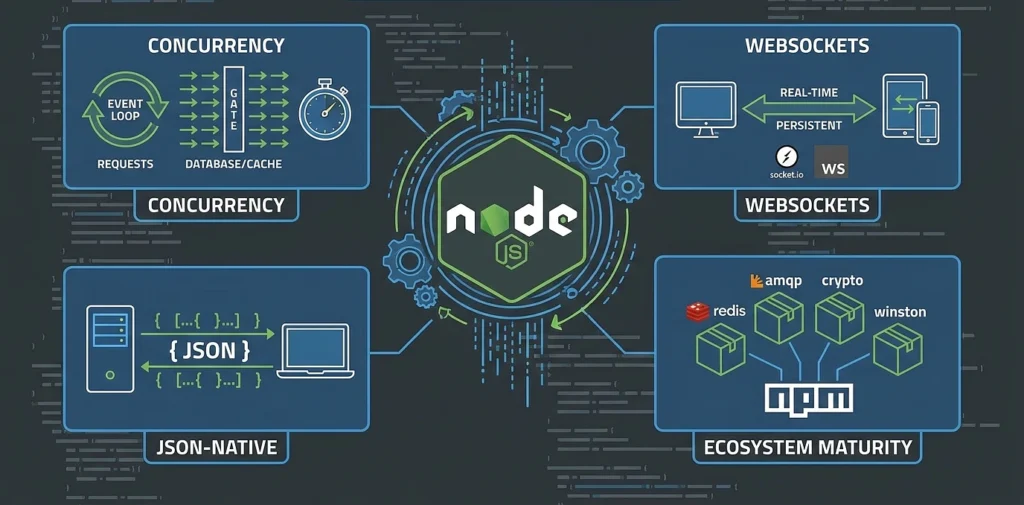
Node has become a default choice for this style of platform, and the reasons are practical rather than ideological.
- Concurrency through the event loop. A game backend has to handle thousands of simultaneous spin requests, most of which finish in tens of milliseconds. Node’s non-blocking I/O model is built for exactly this shape of workload many short-lived requests, very little CPU work per request, lots of waiting on database and cache calls.
- WebSocket support out of the box. Real-time spin results need a persistent connection between client and server. Libraries like
socket.ioand the nativewsmodule make this trivial in Node compared to thread-per-connection languages. - JSON-native data flow. Game state moves between client and server as JSON. Node speaks JSON without any serialisation layer in between, which means less code and fewer places to introduce bugs.
- Ecosystem maturity. Redis clients, message queues, cryptographic libraries, logging frameworks, observability tooling all of it exists as well-maintained npm packages.
The Architecture Behind a Spin
A request for a single spin typically flows through five or six distinct services, even on a modest deployment.
- The client (HTML5 canvas, PixiJS, or similar) sends a spin request over a WebSocket or REST endpoint with the bet amount and a session token.
- An API gateway (Express, Fastify, or NestJS) authenticates the request and validates the session.
- The wallet service confirms the user has enough balance and places a hold on the bet amount.
- The game logic service calls the RNG service for a random number, maps it to a reel position, and evaluates the result against the paytable.
- The wallet service settles the transaction debiting the bet, crediting any win.
- The result is returned to the client as JSON, which the front end animates.
Each of these can live as a separate microservice, or they can be modules inside a monolith depending on scale. The separation matters most for the RNG and wallet services, because those are the parts auditors care about.
What a Spin Handler Actually Looks Like
In pseudo-code, the core spin endpoint in a Node.js game backend looks something like this:
javascript
async function handleSpin(req, res) {
  const { sessionToken, betAmount, gameId } = req.body;

  // 1. Validate session and user
  const session = await sessionStore.get(sessionToken);
  if (!session) return res.status(401).json({ error: 'Invalid session' });

  // 2. Lock and debit balance atomically
  const lock = await redis.lock(`wallet:${session.userId}`);
  try {
    const balance = await wallet.getBalance(session.userId);
    if (balance < betAmount) {
      return res.status(400).json({ error: 'Insufficient balance' });
    }
    await wallet.debit(session.userId, betAmount);

    // 3. Generate RNG outcome
    const seed = crypto.randomBytes(32);
    const outcome = rngService.generate(seed, gameId);

    // 4. Map to reels and evaluate
    const reels = mapOutcomeToReels(outcome, gameConfig[gameId]);
    const winAmount = evaluatePaylines(reels, betAmount, gameConfig[gameId]);

    // 5. Credit any winnings
    if (winAmount > 0) {
      await wallet.credit(session.userId, winAmount);
    }

    // 6. Log the transaction
    await txLog.record({
      userId: session.userId,
      gameId,
      betAmount,
      winAmount,
      seed: seed.toString('hex'),
      reels,
      timestamp: Date.now(),
    });

    return res.json({ reels, winAmount, newBalance: balance - betAmount + winAmount });
  } finally {
    await lock.release();
  }
}
That’s the skeleton. The interesting work is what each of those service calls actually does.
The RNG Why it’s the Most Carefully Built Piece
Every result the user sees ultimately traces back to a single number produced by the random number generator. Get this wrong and the whole platform is unsound.
A few non-negotiable rules:
- Never use
Math.random(). It’s not cryptographically secure and its output is predictable given enough samples. It exists for things like UI animations, not for anything that decides money. - Use
crypto.randomBytes()from Node’s built-incryptomodule, or a certified RNG library if the platform is operating under a regulatory licence. - Seed and log every outcome. The seed used to generate each spin gets recorded alongside the result. This makes the entire history reproducible and auditable regulators can take a seed from six months ago, replay it through the same engine, and confirm the recorded result is genuine.
The RTP is not lazy random. It's mathematically engineered. The game designer determines, in advance, a return to players of 96% of all money wagered over the long run, and they create the paytable, reel weighting and bonus probability to achieve this desired outcome in millions of spins. The series of spins is random, but collectively it is mathematically determined.
State Management and the Concurrency Problem
The hardest engineering problem in this architecture isn’t the RNG. It’s making sure the wallet balance stays correct when thousands of operations might touch it per second.
Imagine a user with a $10 balance opens two browser tabs and clicks spin in both simultaneously, each betting $8. Without proper locking, both requests read the balance, both see $10, both deduct $8, and the user has spent $16 with a $10 balance. That’s a double-spend.
Solutions in the Node ecosystem typically involve:
- Redis-based distributed locks (using Redlock or similar) so only one spin operation per user can hold the wallet at a time
- Database transactions at the wallet layer that fail if the balance changes between read and write
- Job queues (BullMQ, RabbitMQ) for high-load scenarios where spin requests get queued and processed in order rather than racing each other
Session state lives in Redis or a similar in-memory store, keyed by token, so reconnects don’t lose the user’s game context.
Real Time Delivery
Most platforms in this category use WebSockets rather than REST for the actual game loop. A REST endpoint is fine for login, balance checks, and game lobby data. But for the spin itself, a persistent connection means:
- The client gets the result without polling.
- The server can push events (bonus triggers, tournament updates, balance changes from other sessions) without the client asking.
- Latency stays low because there’s no TCP handshake on every action.
socket.io is the standard choice. It handles reconnects, falls back to long-polling on bad networks, and provides rooms for grouping connections (useful for live tournament features).Security Layers that Have to be There
A game backend without proper security isn’t viable for long. The non-negotiables:
- Server-authoritative outcomes. The client never decides what happens. It only displays what the server returned. Any data the client sends is treated as untrusted input.
- Token-based authentication. Usually JWT or signed session tokens, with short expiry and refresh flows.
- Rate limiting on spin endpoints. Without it, a malicious client can hammer the server with requests and either DoS it or exploit timing bugs.
- Transaction logs that are append-only. Every debit and credit gets written to a log that can’t be edited after the fact, so any dispute can be reconstructed.
- Input validation everywhere. Bet amounts, game IDs, session tokens all validated against expected ranges and formats before any logic runs.
The client-side animation code can be inspected, modified, and even rewritten by a determined user. None of that matters if the server treats the client as untrusted, which it must.
Testing the Math
This is the part that separates serious implementations from amateur ones. You can’t ship a game where the RTP is wrong the operator loses money, or the regulator pulls the licence, or both.
Standard practice is to run simulation suites before deploy. The test runs the spin engine through ten million or a hundred million simulated spins, with no real users involved, and verifies:
- The actual RTP across the run matches the designed RTP within a tight margin
- The hit frequency (how often any win lands) matches design
- Volatility distribution looks right (a high-volatility game should produce lots of small losses and rare big wins, not a smooth medium)
- No edge cases produce impossible outcomes
These tests run in CI on every change to game configuration or engine code. Math bugs caught in CI are cheap; math bugs caught after launch are not.
The NPM Stack that Usually Shows Up

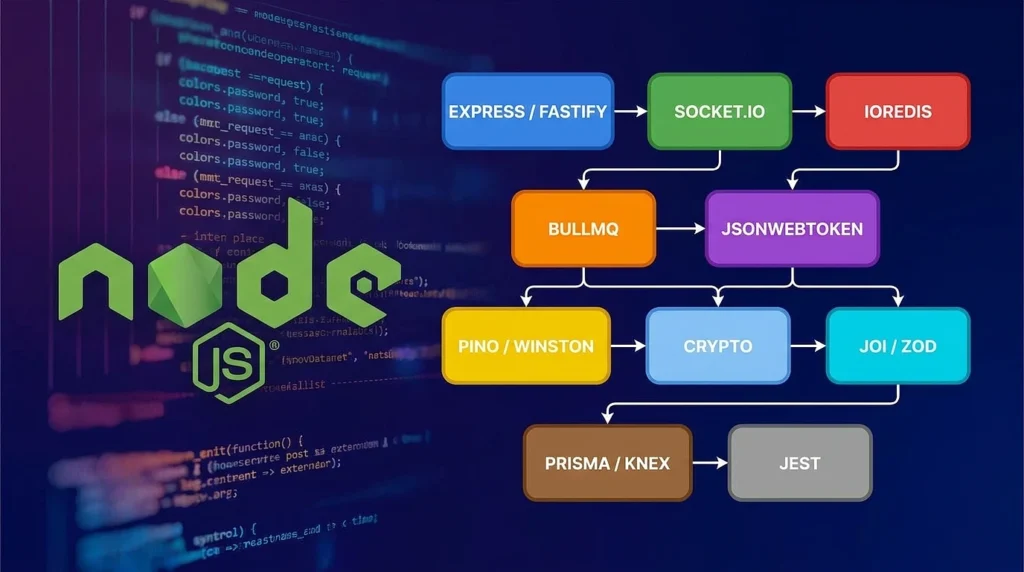
A typical Node-based platform in this pattern reaches for a fairly consistent set of packages:
- express or fastify for the HTTP API layer.
- socket.io for real-time.
- ioredis for session storage and distributed locks.
- bullmq for queued background work.
- jsonwebtoken for auth.
- pino or winston for structured logging.
- crypto (built-in) for RNG and signing.
- joi or zod for input validation.
- prisma or knex for database access.
- jest for the simulation and unit test suites.
None of these are exotic. The skill is in how they’re wired together and where the boundaries between services sit.